

Sunbathing in Hell
Enjoying Climate Change

My friends have mixed feelings about our changing climate. We joke about growing lemons in Canada. If tough change brings opportunities—should we take advantage of them?
Dare we enjoy our new climate?
Not the fires. Not the floods. Not the slow fading of places people thought were permanent.
The extra sun. The longer dry stretches. The strange new growing windows.
If life hands us lemons, we need not apologize for making lemonade. We acknowledge the lemons and get to squeezing.
One year ago I opened a storefront, tucked inside a local vintage store. At the back of the shop, stairs descend through curious decor to the ‘Underground Mall’. In Booth 4, we keep vending machines filled with rare coins. A dragon kite watches over hordes of toys, tableware and fashion accessories.

This location added something “real” to our online storefronts. A place where locals could come to buy vintage collectibles and antiques. Things best seen in person. Difficult to evaluate from pictures. Prohibitive to ship.
But this wasn’t a “climate” project. It was piles of things. Whatever we could restore, price, and move. Over time, the work became something else.
A transaction hub. For our town’s needs, wants, and curiosities.
Stuff comes in. Stuff goes out. Sometimes it comes back again.
We keep things alive a little longer.
But keeping things going has costs.
There’s gasoline in the van.
Cleaning supplies under the sink.
Packaging and parts that came from somewhere far away.
Every object we “save” still burns through time and materials to stay in motion.
Almost every decision is based on value. Not philosophically. Practically.
Is this worth $10?
Worth the shelf space?
Worth the drive?
Does it get a second chance? Donated? Recycled?
Vintage goods are not always used. Sometimes they escaped unopened, still “new” in their original box. Goods are generally at least 20 years old to be considered “vintage,” and older still to be considered “antique.” What they have in common is simpler: they are already made.
By using things already made, we prevent waste. Vintage, pre-owned items, and upcycled products. We hit the usual boxes—reduce, reuse, recycle—the schoolyard mantra printed on bins and repeated everywhere.
But not for free.
Which brings me to my roof.
Days ago, we covered it in a brand new 16 kW solar panel system.
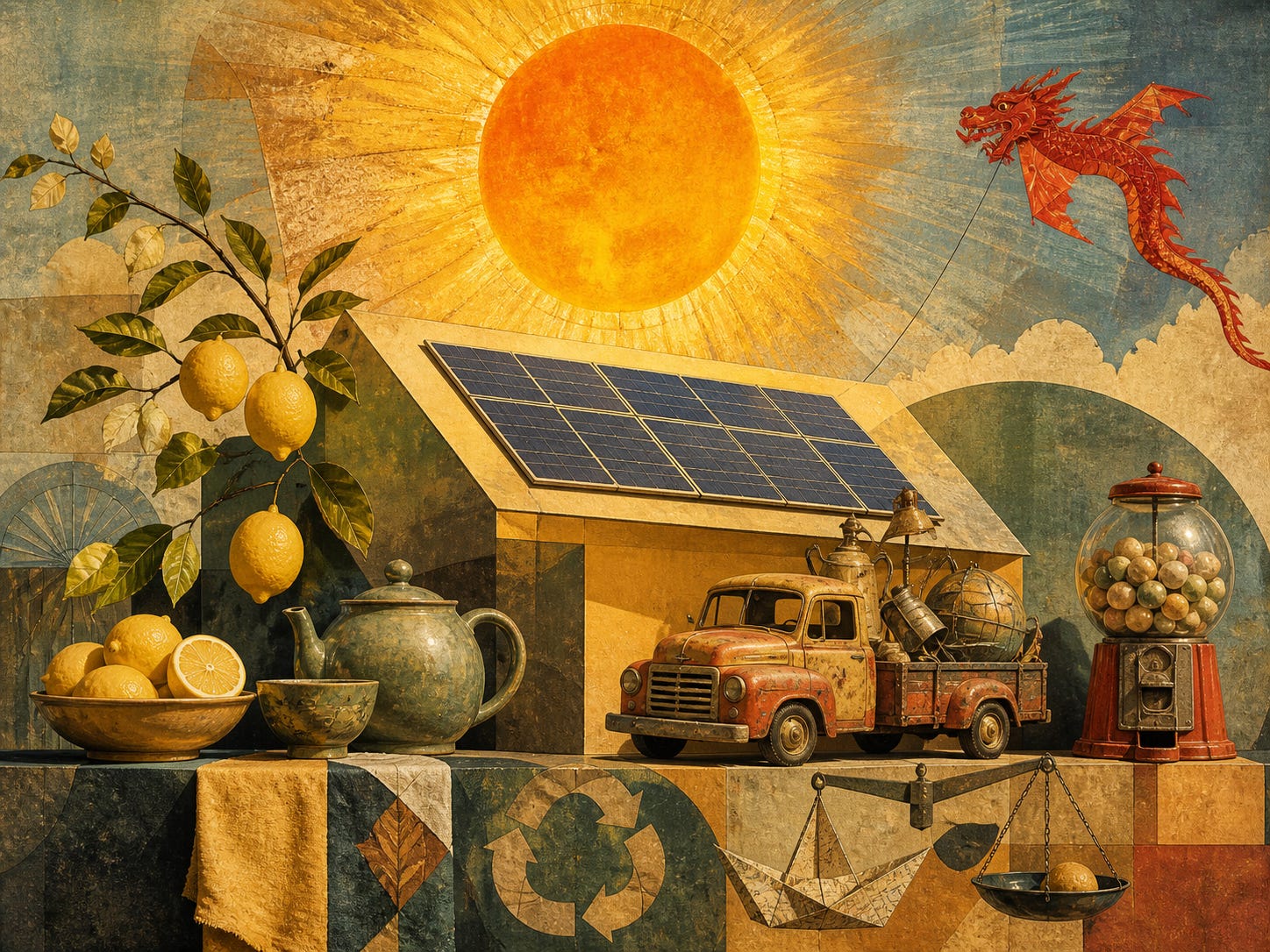
Enough glass, refined silicon, aluminum, copper, silver, and polymers to carry an upfront cost of roughly 15 tonnes of CO₂e. Over 800 kg in total.
In roughly two years, it is projected to have “paid back” its carbon debt, leaving decades in which it could produce as much as 450 megawatt-hours (MWh) of electricity.
A coal plant could burn somewhere in the neighbourhood of 150 to 250 tonnes of coal to generate that much power.
But let’s not dress it up.
Mining still happened.
Factories ran.
Panels crossed oceans.
People got paid, and spent that pay on other things, and the chain kept going.
So maybe the question isn’t:
“Is this good or bad?”
Maybe it’s:
“What kind of pressure did we relieve, and where did it go instead?”
Does it add or relieve infrastructure strain?
Does it lower or raise the cost of living?
Does it improve or worsen the environment?
If I generate power here, I draw less from the system.
It remains available for someone else.
A neighbour. A business. Someone without panels.
What does reduced demand actually change?
Whether we choose new or used, there are always strings attached.
It is hard to be absolutely sure that every choice we make is the right one.
I don’t cheer for the heat.
But if the sun is going to be there anyway…
I’ll use it.